
The Asian Infrastructure Investment Bank(BAII; English acronym: AIIB), is a investment bankproposed by the People’s Republic of China in order to compete with the International Monetary Fund (IMF), the World Bank and the Asian Development Bank1 to address the growing need for infrastructure in Southeast Asiaand Asie centrale. This bank is part of the New Silk Road strategy developed by China.
BAII’s activities
As of January 2020, the BAII has 102 member countries and potential members, including 57 founding members including Australia, China, France, Germany, India, Italy, South Korea, and the UK. As of January 2020, BAII has approved over $12 billion in funding for 64 projects and maintains a list of proposed projects. BAII has received AAA credit ratings from S&P, Moody’s and Fitch.
The BAII positions itself as a “lean, clean and green” institution. It maintains this vision in the projects it funds and in its organizational structure, including a commitment to a lean staffing model and a non-resident board.
The BAII has adopted the operating framework, governance structures and best practices of existing international financial institutions. For example, in March 2017, the BAII adopted the list of individuals and companies sanctioned by all MDBs. The BAII has also established a set of rigorous policies and guidelines, including a Risk Management Framework and an Environmental and Social Framework to support the achievement of social and environmental sustainability outcomes.
History
Established in January 2016 and located in Beijing, the Asian Infrastructure Investment Bank (IIB) is a multilateral development bank (MDB) focused on economic development through infrastructure financing in Asia. With total capital of US$100 billion and a focus on sustainable infrastructure, transnational connectivity, and private capital mobilization, the IAB complements other development efforts in the region
The idea of creating this bank was first mentioned in October 2013, during a visit by Chinese President Xi Jinping to Indonesia. The objective is to promote the development of Asian countries and regional economic integration by meeting infrastructure needs. It is also about building international financial institutions that are less dependent on the United States and strengthening the role of regional actors in decision-making. Emerging countries feel under-represented in existing financial institutions. The reform will have increased China’s voting rights from 4 to 6.4 per cent, which would have placed it just behind Japan but still far behind the United States, whose share would have decreased only slightly from 17.7 to 17.4 per cent. This would have allowed the BRICS countries to be among the 10 countries with the highest quota share, at the expense of Canada in particular. Although signed by U.S. President Barack Obama in 2010, Republicans in the U.S. Congress refused to ratify this International Monetary Fund 2,3 (IMF) reform bill. This blocking is an important element that explains the success of EBIT4,5,6. In general, the BAII, on paper, is trying to repair perceived flaws in the World Bank, the Asian Development Bank, and other development institutions that have been criticized by China for being too unwieldy and too controlled by the United States and other rich nations 7.
In 2014, the U.S. voting power in the IMF 8 and World Bank 9 was 16.75% and 16.21%, respectively (only 3.81% and 4.85% for China). This gives the United States a de facto veto power. For the Asian Development Bank, the voting rights of the United States and Japan are 15.56% and 15.67% respectively and 6.47% for China. In contrast, no single country will have veto power in the new BAII 10. This change in voting rights was the key to gaining European support.
In October 2014, a ceremony to launch the facility was held in Beijing. Twenty-one countries sign a memorandum of understanding to build the Asian Infrastructure Investment Bank: ChinaIndia, the Thailand, the Malaysia, Singapore, the Philippines, the Pakistan, the Bangladesh, the Brunei, the Cambodia, the Kazakhstan, the Kuwait, the Laos, the Burma, the Mongolia, the Nepal, theOman, the Qatar, the Sri Lanka, theUzbekistan and Vietnam11.
Indonesia signed the MOU in November 2014 and became the 22ndfounding country. These countries decide to offer the possibility to other countries to become founding members, subject to acceptance by the members already present, by submitting an application before 31 March 2015.
On March 11, 2015, Luxembourg was the first non-regional country to announce its desire to become a founding member of the Bank. The next day, the United Kingdom, followed by France, Germany and Italy announced their desire to become members of the Asian Infrastructure Investment Bank 12. Switzerland did the same a few days later 13 and Russia also announced its agreement in late March 2015 14.
As for the 57 member countries, Japan is the only major economy in Asia not to apply for membership. Taiwan also requested it, but it was rejected. Even North Korea has applied for membership, but much more economic transparency would have been needed for it to join the bank. Almost all of Western Europe, except Ireland, has officially joined the BAII. The United States, Canada and Mexico have all refused to join, with Washington being particularly critical of the new project, including lobbying its allies not to join. Fourteen European countries – including Great Britain, France and Germany – joined the project in scattered order. For researcher Christophe Jaffrelot, director of research at CERI in Paris, “Beijing will probably manage to forge alliances that will allow it to enjoy a majority coalition within the BAII. But not playing along with this initiative would have been even more counterproductive 2. »
On December 19, 2018, the Board of Directors of the Asian Infrastructure Investment Bank (AIIB), validated the application of six new members, including Algeria, Ghana, Libya, Morocco, and Togo 15.
On March 19, 2018, Canada officially joined the BAII with a 2-year term as one of 12 directors on the BAII Board of Directors starting in July 2018 16.
Geopolitical considerations and governance
In terms of geopolitics, all the BRICS states – Brazil, Russia, India, China and South Africa – have joined the bank. This project will be a complement to the New Development Bankproposed by the BRICS in 2014 17. Moreover, Western European interest in the BAII stands in stark contrast to North America 18. By successfully attracting 57 countries as founding members on June 29, 2015, China achieved a real diplomatic success. In any case, the creation of the BAII represents a major turning point in China’s insertion in the international order.
The governance of the new BAII has not yet been determined, although China is expected to support a 75% split between Asian members and 25% for non-Asian countries, with voting rights within each group allocated according to Gross Domestic Product (GDP). With this governance structure, China would have 43% of the vote, nearly five times more than India. But U.S. allies – the United Kingdom, Germany, France and other European nations, Australia and South Korea in the Asia-Pacific – together would have only 28 percent of the vote.
On the last day before the deadline to become a founding member (March 31, 2015), the United States, through U.S. Treasury Secretary Jacob Lew, announced its willingness to cooperate with the organization. In late March 2015, the heads of the International Monetary Fund, the World Bank, and the Asian Development Bank also expressed their desire for cooperation with the new institution 19.
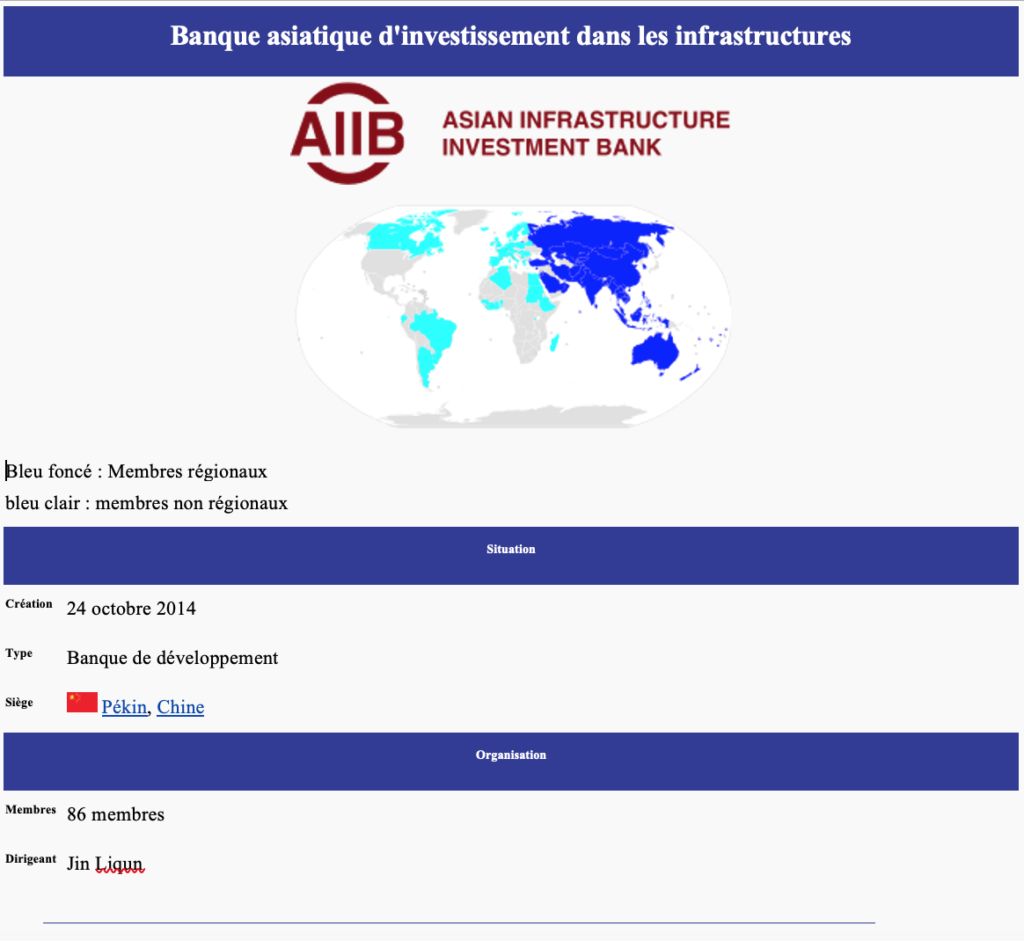
Members
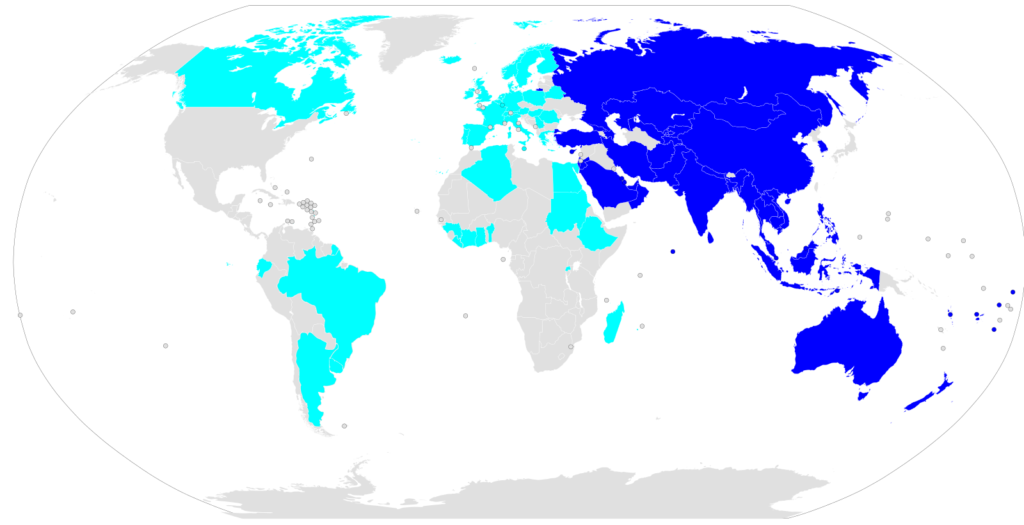
As of January 14, 2022, the bank has 89 members 20.
Members of the Asia-Pacific region
| Country | Membership date |
| Afghanistan | 2019 |
| Saudi Arabia | 2016 |
| Australia | 2015 |
| Azerbaijan | 2016 |
| Bangladesh | 2015 |
| Bahrain | 2018 |
| Burma | 2015 |
| Brunei | 2015 |
| Cambodia | 2016 |
| China | 2015 |
| South Korea | 2015 |
| Cyprus | 2018 |
| Croatia | 2021 |
| United Arab Emirates | 2016 |
| Fiji | 2017 |
| Georgia | 2015 |
| Hong Kong | 2017 |
| Cook Islands | 2020 |
| India | 2016 |
| Indonesia | 2016 |
| Iran | 2017 |
| Israel | 2016 |
| Jordan | 2015 |
| Kazakhstan | 2016 |
| Kyrgyzstan | 2016 |
| Laos | 2016 |
| Malaysia | 2017 |
| Maldives | 2016 |
| Mongolia | 2015 |
| Nepal | 2016 |
| New Zealand | 2015 |
| Oman | 2016 |
| Uzbekistan | 2016 |
| Pakistan | 2015 |
| Peru | 2022 |
| Philippines | 2016 |
| Qatar | 2016 |
| Russia | 2015 |
| Samoa | 2018 |
| Singapore | 2015 |
| Sri Lanka | 2016 |
| Tajikistan | 2016 |
| Thailand | 2016 |
| East Timor | 2017 |
| Tonga | 2021 |
| Turkey | 2016 |
| Vanuatu | 2018 |
| Vietnam | 2016 |


Non-regional members
| Country | Membership date |
| Algeria | 2019 |
| Germany | 2015 |
| Argentina | 2021 |
| Austria | 2015 |
| Belgium | 2019 |
| Benin | 2020 |
| Belarus | 2019 |
| Brazil | 2020 |
| Canada | 2018 |
| Chile | 2021 |
| Ivory Coast | 2020 |
| Denmark | 2016 |
| Egypt | 2016 |
| Ecuador | 2019 |
| Spain | 2017 |
| Ethiopia | 2017 |
| Finland | 2016 |
| France | 2016 |
| Ghana | 2020 |
| Greece | 2019 |
| Guinea | 2019 |
| Hungary | 2017 |
| Ireland | 2017 |
| Iceland | 2016 |
| Italy | 2016 |
| Liberia | 2021 |
| Luxembourg | 2015 |
| Madagascar | 2018 |
| Malta | 2016 |
| Norway | 2015 |
| Netherlands | 2015 |
| Poland | 2016 |
| Portugal | 2017 |
| Romania | 2018 |
| Rwanda | 2020 |
| United Kingdom | 2015 |
| Serbia | 2019 |
| Sudan | 2018 |
| Sweden | 2016 |
| Switzerland | 2016 |
| Uruguay | 2020 |


.svg?uselang=fr)


.svg?uselang=fr)


.svg?uselang=fr)


References
- ↑ Gabriel Grésillon, “China to launch its Asian investment bank” [archive], Le Temps, 28 October 2014
- ↑ Go back higher in :a et b Christophe Jaffrelot, « Rest In Peace Bretton Woods ! » [archive], alternatives-internationales.fr (consulté le 17 juin 2015)vv
- ↑ « Les États-Unis sommés d’adopter la réforme du FMI » [archive], Le Monde, 12 April 2014
- ↑“Emerging countries denounce US inaction on IMF reform” [archive], at huffpostmaghreb.com (accessed 20 April 2015)
- ↑ « New-Model Development Finance » [archive] (accessed May 24, 2015)
- ↑ (en) Scott Morris, « No, the US Will Not Join the AIIB – But Here’s One Thing It Can Do », Centre for Global Development, March 20, 2015
- ↑ « How China Plans to Run AIIB: Leaner, With Veto » [archive] (accessed June 24, 2015)
- ↑ (en) « IMF Members’ Quotas and Voting Power, and IMF Board of Governors » [archive], sur imf.org (accessed April 20, 2015)
- ↑ (en) « International Bank for Reconstruction and Development – Subscriptions and voting powers of member countries » [archive], in siteresources.worldbank.org (accessed April 20, 2015)
- ↑ (en) Lingling Wei et Bob Davis, « China Forgoes Veto Power at New Bank to Win Key European Nations’ Support », Wall Street Journal, March 23, 2015 (ISSN 0099-9660, lire en ligne [archive], accessed April 19, 2015)
- ↑ « Pékin signe avec 20 pays pour établir une banque régionale en Asie » [archive], Le Monde, October 20, 2014
- ↑ Fabrice Nodé-Langlois, “Why France is joining the new Chinese development bank” [archive], Le Figaro, 17 March 2015
- ↑ “Participation in the founding process of the Asian Infrastructure Investment Bank” [archive], Federal Council, Swiss Confederation, 20 March 2015
- ↑ (en) Kenneth Rapoza, “Russia Joins China’s Asian Infrastructure Bank, But Doubts Its Power Against IMF”[archive], at forbes.com (accessed 16 April 2015)
- ↑ “Algeria, Morocco and Togo join Asian Infrastructure Investment Bank – Jeune Afrique” [archive], on Jeune Afrique, 3 January 2019 (accessed 7 June 2020).
- ↑ Department of Finance Government of Canada, “The Asian Infrastructure Investment Bank” [Archive], at www.fin.gc.ca, 18 December 2018 (accessed 22 May 2019)
- ↑ (en) « A BRICS development bank: a dream coming true? » [archive], United Nations conference on trade and development, in unctad.org, mars 2014 (consulté le 26 avril 2015).
- ↑ (en) Shannon Tiezzi, « China’s AIIB: The Final Tally » [archive], in thediplomat.com (accessed April 26, 2015)
- ↑ (en) « ADB, IMF, World Bank To Cooperate With China-Led Asian Infrastructure Investment Bank, Leaders Say » [archive], in ibtimes.com (accessed April 26, 2015)
- ↑ Members and Prospective Members of the Bank [archive]
Sources:https://fr.wikipedia.org/wiki/Banque_asiatique_d%27investissement_pour_les_infrastructures https://www.canada.ca/fr/ministere-finances/programmes/politiques-finances-echanges-internationaux/banque-asiatique-investissement-infrastructures.html