Projet de réhabilitation et d’agrandissement du stade de la Réunification de Douala
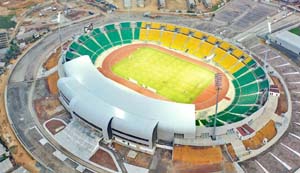
En 2015, le Premier ministre et chef du gouvernement du Cameroun, Philémon Yang, président du Comité d’organisation et de préparation de la Coupe d’Afrique des Nations 2016 et 2019 au Cameroun, avait mandaté Jean Tele Udimba, président du Groupe Diplomat Investment, pour mobiliser 300 millions de dollars et rechercher des entreprises canadiennes en vue de la réhabilitation et de l’agrandissement du Stade de la Réunification de Douala et d’autres infrastructures connexes, d’une capacité de 39 000 places, ainsi que de la rénovation du Stade Roumdé Adjia de Garoua, d’une capacité de 25 000 places. Sur la recommandation du Groupe Diplomat, un consortium a été créé par SODEVI International avec les entreprises suivantes : Canadian Commercial Corporation, Magil Construction et Aedifica, afin de réaliser les travaux. Compte tenu des délais impartis, le consortium s’est limité au Stade de la Réunification de Douala et à d’autres infrastructures.
War in Ukraine: negative impact on global growth in 2022, increased risks for developing countries (United Nations, McKinsey)
Unctad has lowered its forecast for global economic growth in 2022 due to the war in Ukraine and the normalization of economic policies in advanced countries, two factors whose effects will be felt in almost all countries and particularly in developing economies. McKinsey attempts to assess the impact of the war on the Eurozone economy by exploring various scenarios for the evolution of the conflict and the responses of agents. – In the update of its Trade and Development report, UNCTAD, the UN body in charge of trade and development, is revising its global economic growth forecast for 2022 downwards, expecting global GDP to grow by 2.6%, compared to 3.6% in its November 2021 forecast. Due to the war in Ukraine and the macroeconomic policy changes of the past few months, virtually no country will be immune to a deteriorating near-term outlook, although a few will benefit from higher prices for the commodities they export. The growth outlook has been revised downwards, firstly for Russia(by -9.6 points), which will experience a deep recession (-7.3% in 2022) even if the conflict ends quickly. But it has also been revised downwards for the other regions of the world and above all for Central Asia (growth expected to be +0.2% in 2022, i.e. a revision of -2.9 points), followed by South Asia (+4.0%, -1.7 points) and South-East Asia (+3.4%, -1.3 points), the European Union (+1.6%, -1.7 points), of which -1.8 points for Germany and -1.0 points for France, and Africa (-1.1 points). North America (-0.6 points) and Latin America (-0.3 points) would suffer less. The report stresses that the conflict will accentuate the gaps between countries, already noted during the health crisis and then in a “post-Covid” economic recovery at several speeds, at the expense of developing countries. It highlights several risks that concern them primarily. In particular, the conflict is likely to reinforce the trend towards monetary tightening in the advanced countries (the report wonders about a “taper tantrum” scenario as in 2013) while public spending cuts are already planned with the end of the exceptional support programs. The war also creates uncertainty in key international markets (an environment of volatile capital flows, exchange rate instability and rising borrowing costs). This increases the risk of serious external debt payment difficulties for the most fragile countries. UNCTAD estimates that developing countries will need $310 billion to service their external debt in 2022 Source : http://www.rexecode.fr/public/Analyses-et-previsions/Veille-documentaire/Document-de-la-semaine/Guerre-en-Ukraine-impact-negatif-sur-la-croissance-mondiale-en-2022-risques-accrus-pour-les-pays-en-developpement-Nations-Unies-McKinsey Does Russia have the finances to wage war? By Omar Fassal Europe is about to go up in flames. Russia has amassed more than 100,000 troops on its border with Ukraine, and is demanding concrete commitments to curb NATO expansion. This organization, created during the Cold War to protect the continent from a Russian invasion, has gradually taken on new members. But Russia is seriously disturbed by this further expansion. It clearly demands that Nato commit itself never to integrate Ukraine. Americans and Europeans are torn between accepting Russian demands for military de-escalation and supporting a former USSR country that wishes to escape Russian influence. Why is this confrontation dangerous and neither side seems to be giving ground? Because it initiates what will be the new world order. Indeed, the United States, the global hyperpower of the 21st century, is in retreat, unable to play the omnipresent leading role that all empires eventually abandon. The new world order that is taking shape is a multipolar order, with distinct zones of influence. The Atlantic axis dominated by the Americans, the Pacific axis dominated by the Chinese, and the Eastern European axis dominated by the Russians. In the Russian conception, this new order requires that each power respects the limits of the other, and does not try to influence its area. Russia is thus trying to set a precedent: to enforce its zone of influence. If Russia succeeds in this, it will mark a one-way progression towards this multipolar world. Tomorrow, China will be tempted to follow the same muscular approach to settle the dispute over Taiwan. Japan and South Korea, long allied with the Americans for protection, will certainly change sides by moving closer to China, tipping the Pacific axis. Russia has impressive military resources. With 1 million soldiers and 2 million reservists, 1,531 fighter planes, 538 combat helicopters, 13,000 tanks, 214 warships (including 64 submarines), the Russian army is without a doubt one of the most sophisticated in the world. On the other side, the Ukrainian army has professionalized since the 2014 invasion of Crimea, receiving training and $2.5 billion in aid from the Americans, as well as arming civilians for urban guerrilla warfare. Ukrainians promise that they will not throw in the towel in 4 days, as was the case in 2014. But what history teaches us is that war is not just about shells and ammunition; war is primarily about money. Money is the sinews of war. So, can Russia afford a war? The issue is all the more important because the West has clearly stated that it will not intervene militarily to defend Ukraine. In the event of an invasion, they have promised to retaliate by launching “massive economic sanctions without precedent,” according to Boris Johnson. This makes the question even more legitimate: does Russia have the strength to bear the financial fallout? We have to admit that the Russian economy is doing quite well. Russia has actually strengthened its economic independence since 2014 (when a first round of economic sanctions was imposed following the invasion of Crimea). Proof of this is the country’s resilience during the Covid crisis, with real GDP declining by only -2.9% in 2020. Inflation is controlled at 4.8% in 2022. Russia is pursuing a very prudent fiscal policy: a surplus of 3% of GDP in 2018 and 2% in 2019, a deficit of -4% in 2020 and -0.5% in 2021, and now a new budget surplus of 0.1% of GDP expected for 2022 (planned before the military runaway we are experiencing). This fiscal policy has allowed Russia to contain
The Concept of Economic Diplomacy in Quebec
business diplomacy and facilitates the rapprochement between the business and diplomatic communities. It is in this context that Diplomat Investment Magazine has set up an innovative approach of targeted business communication aimed exclusively at major financial leaders and decision-makers, investors and economists in emerging countries. The Magazine focuses on the major movements of capital and investment on a global scale through the new business and economic diplomacy. More than a simple magazine, Diplomat Investissement Magazine has become a very influential information and communication tool that promotes strategic investments and diplomacy. Its philosophy consists in marrying the diplomatic world with that of investments and high finance. To put this concept of economic diplomacy into practice, Mr. Jean Tele Udimba founded in 1998 in Montreal a renowned organization, the Canadian Ambassadors and Business Club for Africa (CAECA), where he held the position of Executive Director. The Board of Directors of this Club was composed of 5 African ambassadors accredited to Canada (South Africa, Algeria, Kenya, Cameroon and Senegal) as well as 10 major Canadian companies (SNC Lavalin, Dessau, Lambert Somec, TecsultAlacan, Hydro-Québec, Bombardier, Groupe Chagnon, Canadian Manufacturers and Exporters, etc.). This club has now become the Canadian Council for Africa. One of the major objectives of the Club was to create investment funds for African and Canadian governments and businesses working in Africa. The outcome of this process allowed the Canadian government to create an Investment Fund for Africa (IFCA), which was capitalized at $500 million.
Business meeting bringing together the financial community and serval business people from Quebec and Canada with Chadian President Idriss Déby Itno
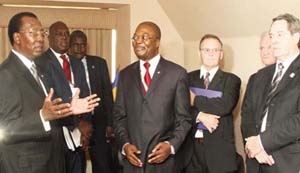
In the margin of the XIIth the Francophonie Summit held in Quebec City in October 2008, the Diplomat Investment Group organized a meeting bringing together several business people from Quebec and Canada to raise $800 million to finance oil and mining projects in Chad. The event allowed about 50 business people to hear President Déby recount the latest events in Chad and, above all, to learn about the economic and social environment prevailing in Toumaï country. Mr. Déby Itno confirmed the return of peace and stability as a guarantee of development. President Déby praised his people and their determination to develop and thus facilitate access to the country for foreign firms, including Canadian ones, so that they can prosper and provide Chadians with a certain expertise. He also announced changes and additions to the Investment Code that would allow foreign companies to enjoy tax exemptions and the new socio-economic landscape that animates Chad. Business opportunities in Chad are numerous, particularly in the fields of oil, mining, infrastructure, housing, health, and education. He therefore invited Canadian business people to Chad in the coming months. Business people came out of their meeting with the president happy and confident of the role they can play in the economic development of this country that has been waiting for its turn for too long now. Memoranda of understanding were signed between Canadian firms and the Chadian government in the oil sector. Mr. Adam Béchir, Chad’s ambassador to Canada with residence in Washington, was charged by the President of the Republic to follow up with Canadian firms based in Toronto.
Grand Inga Project
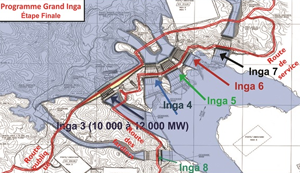
The Grand Inga is today the flagship project of the DRC. Son potentiel est énorme et sa concrétisation pourrait profiter grandement à la RDC et à l’Afrique. Also, to realize the full potential of Inga III estimated at 14 billion dollars that Mr. Jean Tele Udimba, President of the Diplomat Investment Group had organized from 17 to 23 July 2016 a Technical Visit of the DRC delegation composed of advisers of the Presidency of the Democratic Republic of Congo as well as officials of theAgence pour le développement et la promotion du Projet Grand Inga (ADPI), this delegation was hosted by Fasken Martineau in Montreal, Quebec to benefit from exceptional expertise and support in four main areas, namely legal advice, hydroelectric generation and transmission, project financing for mega hydroelectric projects and the creation of public-private partnerships for major infrastructure projects. In order to appreciate the Canadian expertise, a visit was organized to the Robert-Bourassa development of the 15,000 MW La Grande complex in James Bay, as well as to the Robert-Bourassa underground power plant, including the engine room and turbine shafts. This visit made it possible to see the refurbishment of one of the 16 turbines of the Francis-type power plant by Alstom, 2,000 km north of Montreal. The Memorandum of Understanding for professional services between Fasken Martineau and ADPI was signed between the two parties in Kinshasa.
May 2003: Guinean Economic Days in Canada
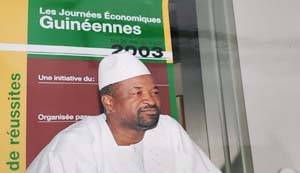
In May 2003, at the request of the Government of Guinea, the Diplomat Investment Group organized the first Guinea Economic Days outside their country, specifically in Montreal, Quebec. This event brought together 8 Guinean ministers (Finance, Economy, Mining, Trade, Agriculture, Infrastructure, Health, Transport and Fisheries) as well as 4 advisors of the Presidency of the Republic, 65 Guinean businessmen and more than 450 Canadian business people. At the end of these days more than 270 million of the protocols of agreement were signed with Canadian partners in the following sectors (Mines, Forestry, Fishing, Telecommunications, Training, Transport, etc).